


The FBI Hydrolysis Technology
Anaerobic digestion is a 4-
Therefore, FBI has developed the partial-

Advantages
Thus, more kind of biomass can be digested. Like wheat and corn straw in China. Instead of burning it which results in a high air pollution, FBI’s biogas plants can digest the straw and turn it into biogas and fertilizer.
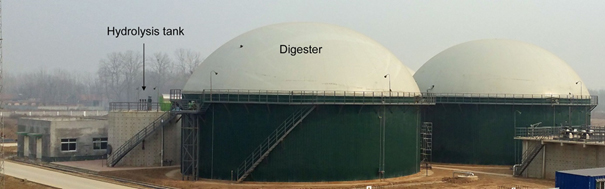
Typical FBI Chinese biogas plant running with pure corn and wheat straw. The Chinese plants have 1 to 6 hydrolysis tanks (350 m3 each) and up to 8 digesters (up to 8’700 m3 each).
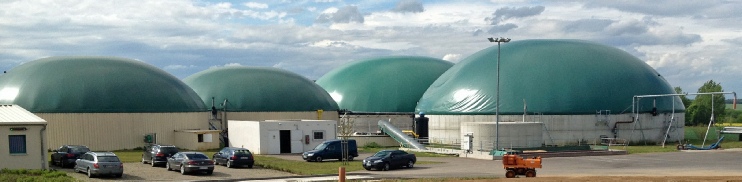
Typical FBI German biogas plant running with manure and corn silage. The German plants have 1 hydrolysis tank (180 m3 each) and up to 3 digesters (up to 2’500 m3 each).
Higher biogas yields
Fibrous organic material with high cellulose and hemi-
Higher methane concentration
In the hydrolysis unit most biological processes for the formation of CO2 take place. The CO2 leaves the unit with the exhaust air. Thus, the biogas has a 3-
Stable fermentation process
With the separation of the sensitive methane forming process from the acidification process the whole fermentation process runs much more stable.
Less digester volume
Due to the much better environment conditions for the methane bacteria less hydraulic retention time (HRT) is necessary. With the FBI hydrolysis pretreatment process an HRT of 20 to 25 days is enough. Thus, digester volumes can be reduced or more biogas can be produced with the same volume.
Trouble-
With the FBI hydrolysis pretreatment technology most of fibrous materials are being liquified and thus pumping and agitating are easier and there are no more floating layers in the digesters.
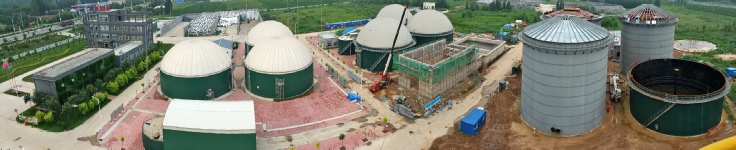
Laoling, China. Biggest Asian biogas plant using FBI’s hydrolysis technology to digest corn and wheat straw. Plant size: 5.5 MW